


Winkelwagen
U heeft geen artikelen in uw winkelwagen
Erythema migrans is een huidafwijking die gezien wordt bij ziekte van Lyme. Het is vaak het eerste symptoom van de ziekte (stadium1). De ziekte van Lyme is een infectieziekte die wordt overgebracht door teken. In Nederland is ongeveer 20% van de teken besmet met de bacterie. Na een tekenbeet van een besmette teek, is de kans op de ziekte van Lyme minder dan 5% als de teek binnen 24 uur verwijderd is
Lack of familiarity with ACA is a major contributor to proper diagnosis and treatment delays. Thus, ACA should be kept on the differential when evaluating skin lesions on the extremities in elderly patients, especially for those with a history of a tick bite. Collaboration between an interprofessional team (dermatologist, rheumatologist, neurologist, cardiologist) is beneficial for patients with multiorgan involvement.
Moniuszko-Malinowska A, Czupryna P, Dunaj J, Pancewicz S, Garkowski A, Kondrusik M, Grygorczuk S, Zajkowska J. Acrodermatitis chronica atrophicans: various faces of the late form of Lyme borreliosis. Postepy Dermatol Alergol. 2018 Oct, 35 (5):490-494. [PMC free article : PMC6232541 ] [PubMed : 30429707 ]
Scott JD. Presentation of Acrodermatitis Chronica Atrophicans Rashes on Lyme Disease Patients in Canada. Healthcare (Basel). 2020 Jun 04, 8 (2) [PMC free article : PMC7349802 ] [PubMed : 32512846 ]
Sigal LH. Current recommendations for the treatment of Lyme disease. Drugs. 1992 May, 43 (5):683-99. [PubMed : 1379147 ]
Stanek G, Strle F. Lyme borreliosis-from tick bite to diagnosis and treatment. FEMS Microbiol Rev. 2018 May 01, 42 (3):233-258. [PubMed : 29893904 ]
Stanek G, Fingerle V, Hunfeld KP, Jaulhac B, Kaiser R, Krause A, Kristoferitsch W, O'Connell S, Ornstein K, Strle F, Gray J. Lyme borreliosis: clinical case definitions for diagnosis and management in Europe. Clin Microbiol Infect. 2011 Jan, 17 (1):69-79. [PubMed : 20132258 ]
Hofmann H, Fingerle V, Hunfeld KP, Huppertz HI, Krause A, Rauer S, Ruf B., Consensus group. Cutaneous Lyme borreliosis: Guideline of the German Dermatology Society. Ger Med Sci. 2017, 15 :Doc14. [PMC free article : PMC5588623 ] [PubMed : 28943834 ]
Vasudevan B, Chatterjee M. Lyme borreliosis and skin. Indian J Dermatol. 2013 May, 58 (3):167-74. [PMC free article : PMC3667275 ] [PubMed : 23723463 ]
McGinley-Smith DE, Tsao SS. Dermatoses from ticks. J Am Acad Dermatol. 2003 Sep, 49 (3):363-92, quiz 393-6. [PubMed : 12963900 ]
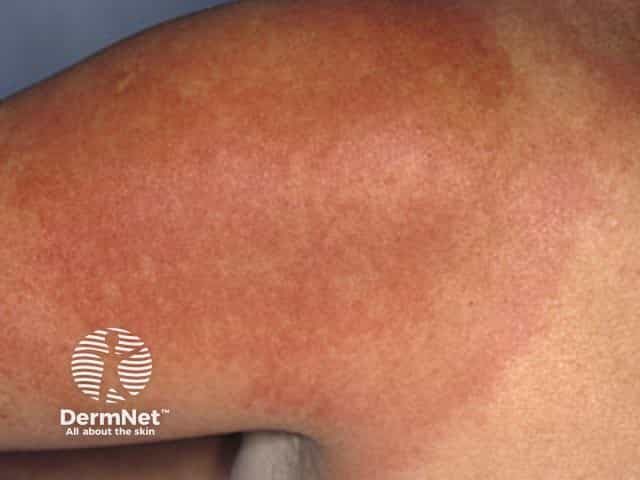
Nicht selten schämen sich die Patienten für die Beschwerden und leiden an Minderwertigkeitskomplexen und an einem verringerten Selbstwertgefühl. Ebenso kommt es durch das Erythema chronicum migrans zu Schmerzen in den Gelenken und vor allem im Rücken. Dadurch tritt nicht selten eine Bewegungseinschränkung auf, die die Lebensqualität deutlich verringern kann.
Der Alltag wird durch eine dauerhafte Übelkeit und Erbrechen deutlich erschwert. Ohne Behandlung kann das Erythema chronicum migrans auch zu Beschwerden am Herzen oder zu Lähmungen führen. Im schlimmsten Falle kommt es zum Herztod des Patienten.
Die Behandlung dieser Krankheit findet mit Hilfe von Antibiotika statt und kann die Beschwerden relativ gut einschränken. Dabei treten keine besonderen Komplikationen ein. Auch die Lebenserwartung wird dadurch nicht verringert, wenn die Behandlung schon frühzeitig beginnt.
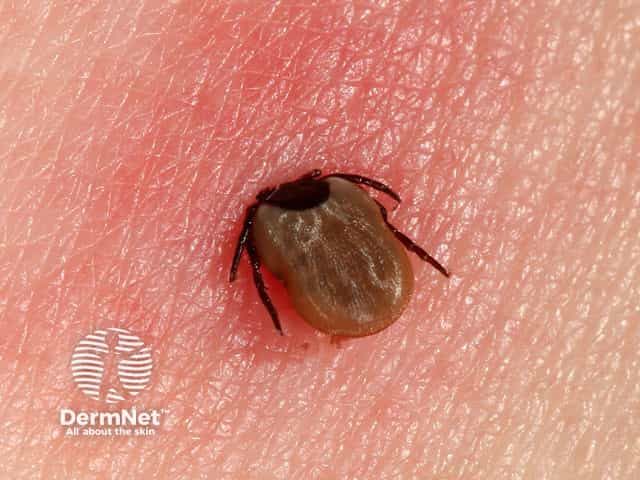
Het Erythema migrans (EM) is kenmerkend voor de ziekte van Lyme en is vaak het eerste symptoom. Het begint als een rood plekje binnen 3-4 maanden na de tekenbeet. Vaak ontstaat het EM 4-10 dagen na de tekenbeet en gemiddeld na 2-3 weken.
Het plekje breidt zich in de loop van dagen tot weken uit tot een min of meer ronde of ovale rode of rood-blauwe vlek, ring of kring van enkele tot tientallen centimeters breed. Op een gekleurde huid kan de vlek of ring er gelig of blauw uitzien.
Het EM kan egaal van kleur zijn of verbleken vanuit het midden en is wegdrukbaar, wat betekent dat de plek even verbleekt als je er op drukt. Bij de diagnose wordt vaak een minimum van 5 cm aangehouden, maar dit kan voor een individuele patiënt een te beperkend criterium zijn als het EM snel optreedt en nog klein is.
Het EM kan een licht branderig, warm of jeukend gevoel geven, maar dat hoeft niet. Bij een klein deel van de mensen kan de plek een beetje gevoelloos of juist gevoeliger aanvoelen of wat verdikt zijn, soms aan de randen. Er kan in sommige gevallen nog een heel klein wondje zichtbaar zijn op de plaats waar de teek heeft gezeten.
Plaatsen op het lichaam waar het EM vaak optreedt zijn de benen, liezen, romp, armen en oksels. Bij kinderen komt een EM vaker dan bij volwassenen in de hoofd-halsregio voor, waarbij het EM zich op een gezicht soms vluchtig, onscherp begrensd en vlekkerig kan vertonen, waardoor dit bij kinderen verward zou kunnen worden met de vijfde ziekte (parvovirus b19).
Erythema Migrans, rode ring of vlek bij de ziekte van Lyme
In plaats van één ring of vlek kunnen er ook meerdere vlekken (meervoudige of multipele EM) ontstaan. Deze zijn meestal ovaal vlek-vormig en vaak duidelijk begrensd. Het meervoudige EM wijst op een al uitgezaaide infectie en vergt een langere antibioticabehandeling dat een enkelvoudig EM.
