


Winkelwagen
U heeft geen artikelen in uw winkelwagen
Pityriasis rosea-uitslag wordt gekenmerkt door een onderscheidend en enigszins mysterieus uiterlijk op de huid. Hoewel het over het algemeen goedaardig en zelfbeperkend is, kan het herkennen van de tekenen en het begrijpen van de onderliggende mechanismen cruciaal zijn voor effectief beheer en verlichting.
Volg en beheer uw eczeembehandeling met behulp van een uitgebreide eczeem-app
Download Eczemaless nu
Hoewel de huiduitslag door pityriasis rosea over het algemeen goedaardig is, zijn er gevallen waarin het raadzaam is om een dermatoloog of zorgverlener te raadplegen:
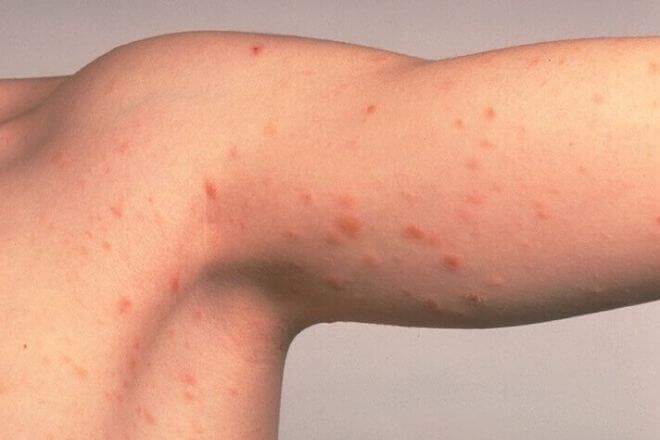
These secondary lesions occur as macules and papules that are elliptical or ovular in shape. Fine scaling and central wrinkling with a cigarette-paper aspect are seen. A characteristic feature of PR is the collarette appearance of the scale, with edges peripherally attached and lifted near the center of the lesion. The distribution of the lesions is usually bilateral and diffuse, with the long axis running parallel to skin tension lines.
The incidence of atypical PR is 20%, which may be due to the morphology, size, and distribution of lesions, as well as the symptoms or course of the condition. The various atypical morphologies include: [21]
Vesicular PR: This condition presents as a generalized eruption of 2- to 6-mm vesicles or as a rosette of vesicles, mainly over the head, palms, and soles, it is commonly seen in children and needs to be differentiated from varicella and dyshidrosis.
Purpuric (hemorrhagic) PR: This condition presents as macular purpura on the skin or oral mucosa.Generalized papular PR: This condition presents as multiple papules that occur along with classic patches and plaques, it is seen in young children, pregnant women, and African Caribbeans.
Lichenoid PR: This condition is observed in the course of atypical PR, but it is more commonly caused by drugs such as gold compounds, captopril, barbiturates, D-penicillamine, and clonidine.
Giant PR: This condition consists of plaques and circles of very large sizes ranging from 5 to 7 cm, with individual lesions reaching the size of the patient's palm, it was named after Darierand and is rarely reported.
Inverse PR: In this condition, lesions are predominantly present in acral and flexural areas involving the axilla, groin, and face. [22]
Acral PR: In this condition, lesions are more concentrated over acral parts of the body (ie, palms and soles), where erythema multiforme, syphilis, necrolytic acral erythema, and drug eruptions should be kept as differentials.

The large patch usually develops on the back, chest, or abdomen, however, it can develop anywhere on the skin, including the armpit.
If you have light-colored skin, this patch tends to be oval, slightly raised, and pink to salmon in color. The center is often covered with fine white scale.
If you have darkly pigmented skin, this oval patch tends to look dusky violet to deep brown in color.
The patch can appear anywhere on the skin, but it often develops on the belly, chest, or back. No matter where it appears, it tends to grow, usually for about 2 weeks, before more patchers or spots appear.
As a large patch tends to be the first sign of pityriasis rosea, this patch is often given one of the following names:
Smaller patches or bumps: In about 2 weeks, smaller patches or tiny bumps often appear. People who have light-colored skin usually develop patches that look like smaller versions of the herald patch. If you have darkly pigmented skin, small, raised bumps tend to appear.
The rash can also look like another skin condition, such as hives, nummular eczema, or psoriasis.
