


Winkelwagen
U heeft geen artikelen in uw winkelwagen
MHS orthopaedic implant reaction is becoming more important to understand. The number of total joint arthroplasty patients testing positive for MHS has increased exponentially over the last 20 years. 14 Furthermore, it is estimated that 11 million individuals will be living with total hip or knee arthroplasties (4 million total hip, 7.4 million total knee) by 2030. 15 Therefore, a better understanding of the risk, diagnostic, and treatment dilemmas is important. This review article will provide a guide to understand the epidemiology and pathophysiology of hypersensitivities, assess and interpret the clinical history, and provide our clinical recommendations.
The most commonly reported failure mechanism for metallic implants has been reported for total joint arthroplasty (TJA). In the United States it is estimated that 8.4% of total knee arthroplasties (TKAs) are revisions, while 10.7% of total hip arthroplasties (THA) are revisions. 19 Other studies have estimated annual revision rates between 10% and 20% of all lower extremity TJAs. 1 , 20 Sharkey et al. described the reason for revision of 781 TKAs that included loosening (40%), infection (27.5%), instability (7.5%), periprosthetic fracture (4.5%), and arthrofibrosis (4.5%). 21 Similarly, Sadoghi et al. reported the most common causes for TKA revision were aseptic loosening (29.8%), septic loosening (14.8%), pain (9.5%), and wear (8.2%). 22 For THAs, the most common causes for revision were aseptic loosening (55.2%), dislocation (11.8%), septic loosening (7.5%), and periprosthetic fractures (6%). 22 Jafari et al. in another study equated the failure mechanisms for THA revisions as aseptic loosening (51%), instability (15%), wear (14%), infection (8%), fracture (5%), and miscellaneous (7%). 23 Because routine evaluation for MHS is uncommon, the role of MHS as a cause of failure is poorly understood and underappreciated in mechanism and incidence.
De oorzaak is, ondanks veel onderzoek, niet duidelijk. Er zijn wel verschillende ‘verdachte’ uitlokkende factoren die als mogelijke oorzaak worden genoemd. De meest bekende zijn:
aanleg voor constitutioneel eczeem
mensen die als kind veel last hebben gehad van constitutioneel eczeem (eczeem in de plooien van knieen en ellebogen en gezicht) of nog steeds dit eczeem hebben, zouden mogelijk een verhoogd risico hebben op het ontwikkelen van dyshidrotisch eczeem.
metalen in de voeding/ drinkwater
in sommige onderzoeken is bij mensen met een nikkelallergie een relatie gelegd tussen de inname van grote hoeveelheden nikkel en handeczeem. Ditzelfde geldt voor het metaal chroom. Bij een normaal dieet is een relatie tussen handeczeem en nikkel of chroom vrijwel uitgesloten.
schimmelinfecties
een schimmelinfectie (meestal aan de voeten) kan aanleiding geven tot een beeld van dyshidrotisch eczeem aan de handen. De manier waarop deze ‘reactie op afstand’ of autoeczematisatie ontstaat is nog niet geheel opgehelderd. Het loont echter zeker de moeite om in het geval van een dyshidrotisch eczeem aan de handen een lokale schimmelinfectie elders op het lichaam te behandelen, ook al geeft deze geen klachten.
onbekend
helaas wordt, ondanks adequaat onderzoek, bij 80% van de mensen met een dyshidrotisch handeczeem nooit een oorzaak van het eczeem gevonden.

Nickel is part of many metal alloys (combinations of metals) and is often used to plate metal alloys.
Symptoms can range from mild to disabling, depending on how sensitive you are. Symptoms may include:
These signs usually only appear where the nickel touches your skin. However, in some severe cases, swelling and redness can spread to other areas of your body, as well.
Some people have a systemic nickel allergy that involves:
Nickel allergy can be acquired anytime during your lifetime, unlike some allergies like food allergies that often occur very early in life.
Your sweat and other bodily fluids can leach nickel from stainless steel and other alloys. Then your skin absorbs the metal. The allergy is often caused by direct and prolonged exposure to items that release a lot of nickel. Once you’re sensitized to it, even small amounts of nickel exposure may be a problem.
Allergies are a “misfire” of your immune system. In an allergy, your immune system mistakes something harmless as a threat to your health, like a virus or bacterium. It then tries to rid your body of it, which is what leads to inflammation and other symptoms. The immune response involves sending specialized cells to go after the target substance.
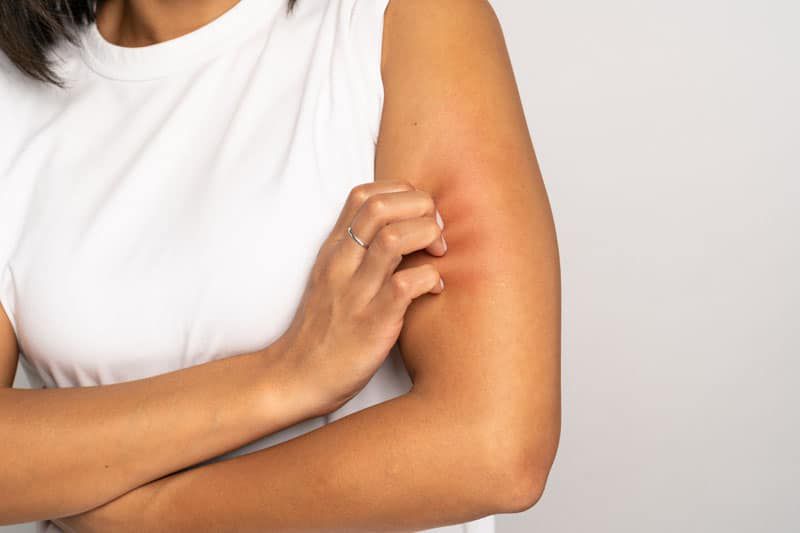
Es ist nicht möglich, zu verhindern, dass eine Nickelallergie entsteht. Betroffene haben jedoch durch verschiedene Maßnahmen die Möglichkeit, dem Aufblühen der Allergie und Symptomen wie Hautausschlag vorzubeugen. Die wichtigste ist es, den Kontakt mit Nickel zu meiden.
Nickel ist unter anderem enthalten in:
Auch in Goldschmuck ist häufig ein geringer Anteil Nickel enthalten. Viele Nickelallergiker haben jedoch keine Probleme, diesen zu tragen.
Nickel ist außerdem Bestandteil von Tabakrauch. Rauchen Sie deshalb nicht, wenn Sie an einer Nickelallergie leiden. Es ist möglich, dass Tabakrauch Symptome verursacht oder verschlechtert. Auch Passivrauchen gilt es zu vermeiden.
Falls es berufsbedingt nicht möglich ist, Nickel zu meiden, empfehlen Ärzte Betroffenen, Schutzkleidung wie Schutzhandschuhe zu tragen.