


Winkelwagen
U heeft geen artikelen in uw winkelwagen
Drug induced exfoliative dermatitis (ED) are a group of rare and severe drug hypersensitivity reactions (DHR) involving skin and usually occurring from days to several weeks after drug exposure. Erythema multiforme (EM), Stevens–Johnson syndrome (SJS) and toxic epidermal necrolysis (TEN) are the main clinical presentations of drug induced ED. Overall, T cells are the central player of these immune-mediated drug reactions. Here we provide a systematic review on frequency, risk factors, pathogenesis, clinical features and management of patients with drug induced ED.
Cutaneous drug eruptions are one of the most common types of adverse reaction to medications, with an overall incidence of 2–3 % in hospitalized patients [1]. In particular, drug induced exfoliative dermatitis (ED) are a group of rare and more severe drug hypersensitivity reactions (DHR) involving skin and mucous membranes and usually occurring from days to several weeks after drug exposure [2]. Erythema multiforme (EM), Stevens–Johnson syndrome (SJS) and toxic epidermal necrolysis (TEN) are the main clinical presentations of drug induced ED. Important data on ED have been obtained by RegiSCAR (European Registry of Severe Cutaneous Adverse Reactions to Drugs: www.regiscar.org), an ongoing pharmaco-epidemiologic study conducted in patients with SJS and TEN. Overall, T cells are the central player of these immune-mediated drug reactions. Immune-histopathological features allow to distinguish generalized bullous drug eruption from SJS/TEN [3–6]. Still, treatment indication, choice and dosage remain unclear, and efficacy yet unproven. Here we provide a systematic review of frequency, risk factors, molecular and cellular mechanisms of reactions, clinical features, diagnostic work-up and therapy approaches to drug induced ED.
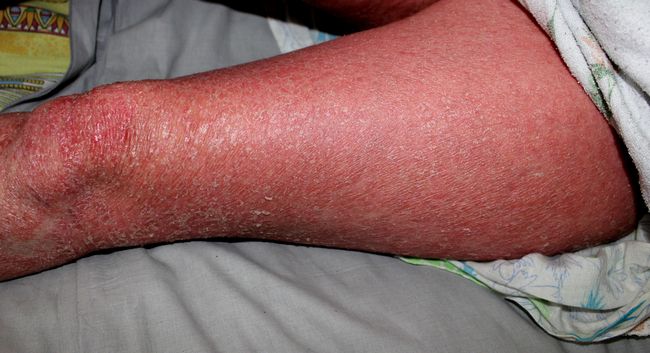
Exfoliative dermatitis is a skin condition in which the skin becomes inflamed (dermatitis) and the skin peels-off (exfoliation) over large areas of the body. The affected areas become reddened (erythema), accompanied by irritation and pain. This condition can occur due to pre-existing skin disorders, cancer, drug-induced (iatrogenic) or without any known cause (idiopathic).
Generalized exfoliative dermatitis in which the peeling of skin occurs extensively (more than 90% of the body surface), the condition is termed as erythroderma. The condition was first described by Von Hebra in 1868.
Exfoliative dermatitis occurs in all races and ethnic groups, with men being affected more than women (male-to-female ratio varies between 2:1 and 4:1). The average age of onset can vary from 52 to 60 years.
The actual incidence of exfoliative dermatitis is unknown. A handful of studies have been carried out across the globe. With regard to the Indian population a large prospective study involving 80 patients was carried out where it was found that the incidence of exfoliative dermatitis is 35 per 100,000 dermatologic out-patients.

ผู้ที่ป่วยด้วย Exfoliative Dermatitis จะเกิดผื่นแดงอักเสบเป็นวงกว้างเกือบทั้งตัว ผิวหนังอาจเปลี่ยนเป็นสีชมพูหรือม่วง ร่วมกับมีสะเก็ดหลุดเป็นขุยหรือแผ่น และอาจสะสมจนเป็นแผ่นหนา สภาพผิวแห้งสาก มีอาการเจ็บบริเวณผื่นและคันอย่างรุนแรง ร่วมกับอาการอื่น ๆ ดังนี้
ผู้ป่วยควรไปพบแพทย์โดยเร็วที่สุดเมื่อสังเกตเห็นอาการผิดปกติที่เข้าข่าย Exfoliative Dermatitis เพื่อที่จะได้รับการรักษาโดยเร็วที่สุดและป้องกันการเสียชีวิต
Om de getroffen huid van het ontwikkelen van een infectie en om vloeistoffen en eiwitten vast te houden, zijn vroege diagnose en ondersteunende behandeling van exfoliatieve dermatitis van vitaal belang. Meestal voert een dermatoloog de behandeling voor exfoliatieve dermatitis uit.
Vaak moeten degenen met ernstige exfoliatieve dermatitis in het ziekenhuis worden opgenomen en krijgen ze intraveneus (via de aderen) vloeistoffen en zouten en antibiotica voor de infectie. Dit corrigeert eventuele uitdroging, warmteverlies, voedings- of elektrolyttekorten, laag bloedvolume en om het probleem te behandelen.
Een van de belangrijkste doelen van de behandeling is om de ontsteking te verminderen en u comfortabeler te maken. Ondersteunende zorg bestaat uit orale antihistaminica, rust, warme baden en verwarmde dekens om de lichaamstemperatuur onder controle te houden. Soms kan een medicinale crème helpen om je droge, jeukende huid te bevochtigen.
Steroïde medicijnen zijn vaak de remedie voor degenen die ernstige of chronische ontsteking en schilfering van de huid ervaren. Een paar gevallen vinden verlichting in fototherapie of lichttherapie, die wordt gedaan met behulp van psoralen, een lichtgevoelig medicijn en ultraviolet licht.
Of het nu gaat om exfoliatieve dermatitis op het gezicht, de handen of ergens anders op het lichaam, hier zijn een paar behandelingen die u kunt verwachten te ondergaan.
Vanwege de afwezigheid van de eerste laag van de huid, is het gebruikelijk dat vloeistoffen gemakkelijk uit het lichaamsoppervlak ontsnappen, wat leidt tot uitdroging. Als het niet serieus wordt genomen, kan uitdroging levensbedreigend zijn.
Daarom is rehydratatie erg belangrijk. U kunt oraal rehydrateren, of het wordt intraveneus toegediend in een ziekenhuis.
Je lichaam heeft een delicate balans van vloeistoffen en elektrolyten. Van het samentrekken van spieren tot het geleiden van nerveuze impulsen, elektrolyten helpen het lichaam te functioneren zoals het zou moeten.
The prognosis or outlook for exfoliative dermatitis can vary from patient-to-patient and depends on the cause.
Published on Jan 03, 2018
Last Updated on Jun 29, 2018