

Winkelwagen
U heeft geen artikelen in uw winkelwagen
Acne keloidalis nuchae (AKN) also known as folliculitis keloidalis nuchae (FKN) is one of the chronic forms of scarring folliculitis seen mostly in men of African descent. 1 Although the term “folliculitis keloidalis nuchae” captures the follicular nature of the disorder and is preferred by some, the lesions develop past the nuchal area suggested by the terminology. The term AKN is commonly used although it is generally agreed that the condition is not a keloid, and affected individuals do not have a tendency to develop keloids in other areas of the body. Acne keloidalis (AK) lesions do not have histological features suggestive of a keloids. 2
Hebra in 1860 first used the terminology sycosis framboesiformis although it had been described as a distinct entity in the late 1800s. 3 In 1869, Kaposi referred it to as dermatitis papillaris capillitii, and in 1872, Bazin coined the term AKN. 4 The exact cause of AKN remains unknown. The inciting agents appear to be multifactorial with various factors such as androgens, inflammation, infection, trauma, genetics, and ingrowing hairs being implicated. It shares some similar features with other forms of cicatricial alopecia and may occur together in the same individual. It has been classified as a mixed form of the primary cicatricial alopecia by the North American Hair Research Society. 5 It is characterized by papules, pustules, and sometimes tumorous masses in the nuchal or occipital regions of the scalp hence the name “bumps” evolved in the environment. 6 Despite its common occurrence, treatment may be challenging. This review highlights the epidemiology, clinical features, impact, and treatment challenges.
AKN occurs majorly in those of African descent. It has been reported in a few Caucasians and other ethnic groups. 7 It is predominantly a disorder of males although there are a few reports in females with a male to female ratio of 20:1. 8 , 9 Reports from Nigeria give a prevalence ranging from 0.7% to 9.4%, 10 – 12 while in Benin in West Africa the prevalence is 0.7%. 13 In South Africa, a prevalence of 4.7% was seen in boys in their last year of school and 10.5% in older men. 14 In African-Americans, the reported prevalence ranges from 0.5% to 13.6%. 5 , 16 The latter was in American footballers who wore headgears for protection. Their Caucasian counterparts wearing the same headgears did not develop AKN.
Pseudofolliculitis barbae (PFB) is a chronic inflammatory condition characterized by follicular and perifollicular papules and pustules primarily affecting the beard and neck area. PFB is a condition that predominantly affects patients with skin of colour. The objective of this paper is to review the epidemiology, pathogenesis and presentation of PFB, and assess the most recent evidence-based treatment options and recommendations for PFB. This is important to increase the quality of care given to target patient populations and to address the prominent disparity in healthcare management of patients with skin of colour. A literature review was conducted utilizing PubMed and Cochrane Library. The key term ‘pseudofolliculitis barbae’ was used. Search parameters were set to search from 1987 to the present. Results were further narrowed by limiting the literature review to published observational studies, case studies, case series, randomized control trials and case–control studies. Effective treatment for PFB requires a multifaceted approach that targets various aspects of the pathogenesis. Current treatments include preventive measures, antibiotics, corticosteroids, keratolytics, chemical depilatories and/or laser treatments. Topical therapies are currently the mainstay treatment. However, laser hair removal has become a potential long-term treatment option, and additional studies are warranted to understand its long-term efficacy and permanency.
Pseudofolliculitis barbae (PFB) is a chronic inflammatory condition characterized by skin-coloured to erythematous, follicular or perifollicular papules and pustules primarily affecting the beard and neck area. 1 PFB is a condition that predominantly affects patient populations with skin of colour. 2 To increase the quality of care given to these target patient populations and address the prominent disparity in healthcare management of these groups, it is important to expand the knowledge base for management and treatment of this condition. In this article, we briefly discuss the epidemiology, pathogenesis and presentation, followed by an updated review of treatment of PFB.

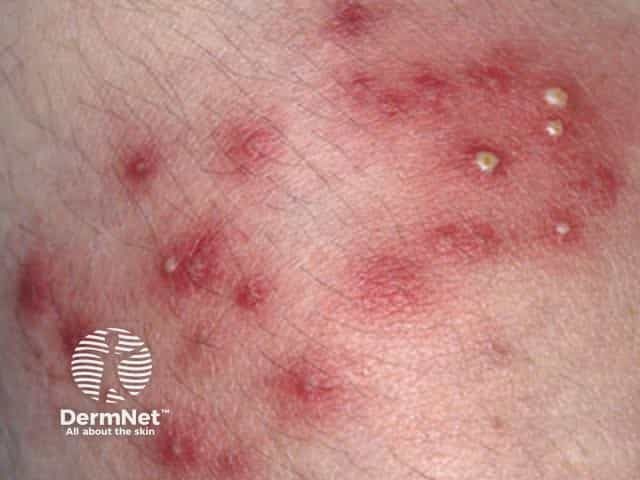
Patient with pseudofolliculitis barbae with both inflammatory lesions and postinflammatory inflammation.
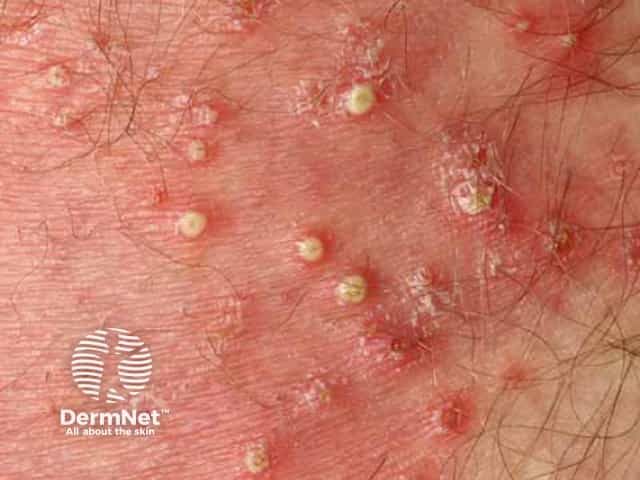
A close-up of multiple perifollicular papules with extrafollicular and transfollicular penetration.