


Winkelwagen
U heeft geen artikelen in uw winkelwagen
Childhood pityriasis rosea is much less common than in adulthood [2,4]. In a study of pityriasis patients in central India, the average age was 20.32 years. The distribution of ages (n=40) was as follows: 37.5% ages 11-20, 45% ages 21-30, 10% ages 31-40, 5% ages 41-50, and 2.5% ages 51-60 [8]. No patient with pityriasis rosea in that study was between the ages of 0-10 years. However, as this study presented a case within that range, it is important to maintain a high index of suspicion when a young patient exhibits these symptoms. Although there isn’t a significant association with gender, the same study in central India showed a 1.3:1 female-to-male ratio of pityriasis rosea patients in the population of patients that they studied [8].
More than a single herald patch is also unusual. This occurs in roughly 2% of pityriasis rosea patients [2]. However, in this case, the patient presented with two herald patches, so it is important for physicians to be aware of this atypical morphology. Just as in other cases of non-severe pityriasis rosea, this patient did not require any prescribed treatment and recovered in the expected period of time. Physicians should be aware, however, that although pityriasis rosea usually lasts several weeks, there have been reports of the disease lasting from two to three months [5]. Pityriasis rosea has been known to relapse occasionally (1.8-3.7% rate) because of the development of immunity. Relapse pityriasis rosea tends to occur without the presentation of a herald patch and, if it occurs at all, will often occur six to 18 months after the initial episode [7].
Pityriasis rosea most commonly occurs between ages 10 and 35 years with 75% of all cases are reported within that age group [3]. It is quite rare for the disease to affect children under 10 years old [7]. However, presentations of pityriasis rosea tend to be similar in both childhood cases and adult cases. Studies have also shown that pityriasis rosea tends to present slightly differently in the black population, with more facial and scalp lesions and a higher chance of post-infection pigmentation changes. Many studies also indicate a marginally higher probability of females being affected by the disease, and pregnant women are particularly susceptible due to a weaker immune response [6].
A school-age male child with a past medical history of asthma presents with his mother for a rash he has had for three days. The rash started on his back then spread to his chest, and then showed multiple smaller spots on his abdomen, arms, legs, and buttocks. On the patient’s left scapular area are three gray scaly oval herald patches aligned on and directly below his shoulder blade (Figure (Figure1). 1 ). The rash is not pruritic or painful but is blanching. His older brother was diagnosed with Influenza A four days prior. He is up to date on his immunizations. He denies cough, neck pain, sore throat, and diarrhea. The patient has no fever, syncope, shortness of breath, tongue swelling, nausea, or vomiting. He has no history of immunocompromise. Further, he denies recent travels, recent tick bite, and medication use, except for various asthma medications.
Rash on patient's back with multiple herald patches on his left scapular area (blue arrows)The patient’s symptoms were not typical for other emergent causes of rash such as cellulitis, abscess, necrotizing fasciitis, vasculitis, anaphylaxis, Stevens Johnson Syndrome (SJS) or toxic epidermal necrolysis (TEN), measles, scarlet fever, and Kawasaki’s. For that reason, the rash is likely pityriasis rosea due to clinical exam and lack of other symptoms. The patient was recommended to follow up if he experienced fever, joint pains, headache, stomach upsets or other pain, or a worsening of his skin rash. It was explained that treatment is supportive, but that over the counter antihistamines could be used for itchiness, and that small doses of ultraviolet light and/or topical lotions could also help. The patient was also recommended to avoid over-bathing and scrubbing.
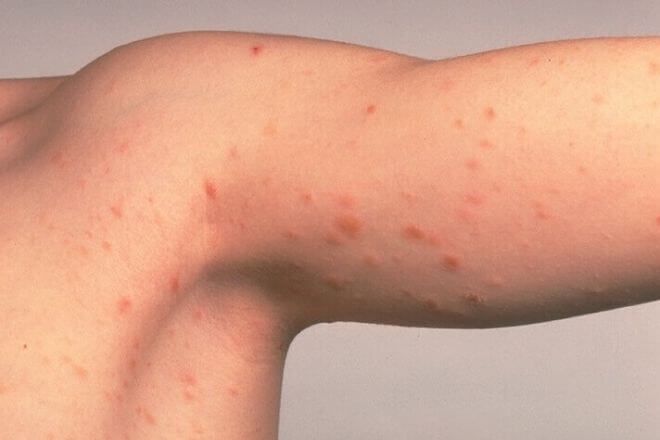
Most of the time, pityriasis rosea rashes look typical. An atypical rash like the one above, however, is not uncommon. The lesions in this photo are not as distinct. Instead, they are more generalized over the area.
The rash can be more papular , or bumpy, in certain people, including:
Infants sometimes get blisters and raised wheals. Oral lesions can happen, too, and in some cases, the rash covers the entire body.


